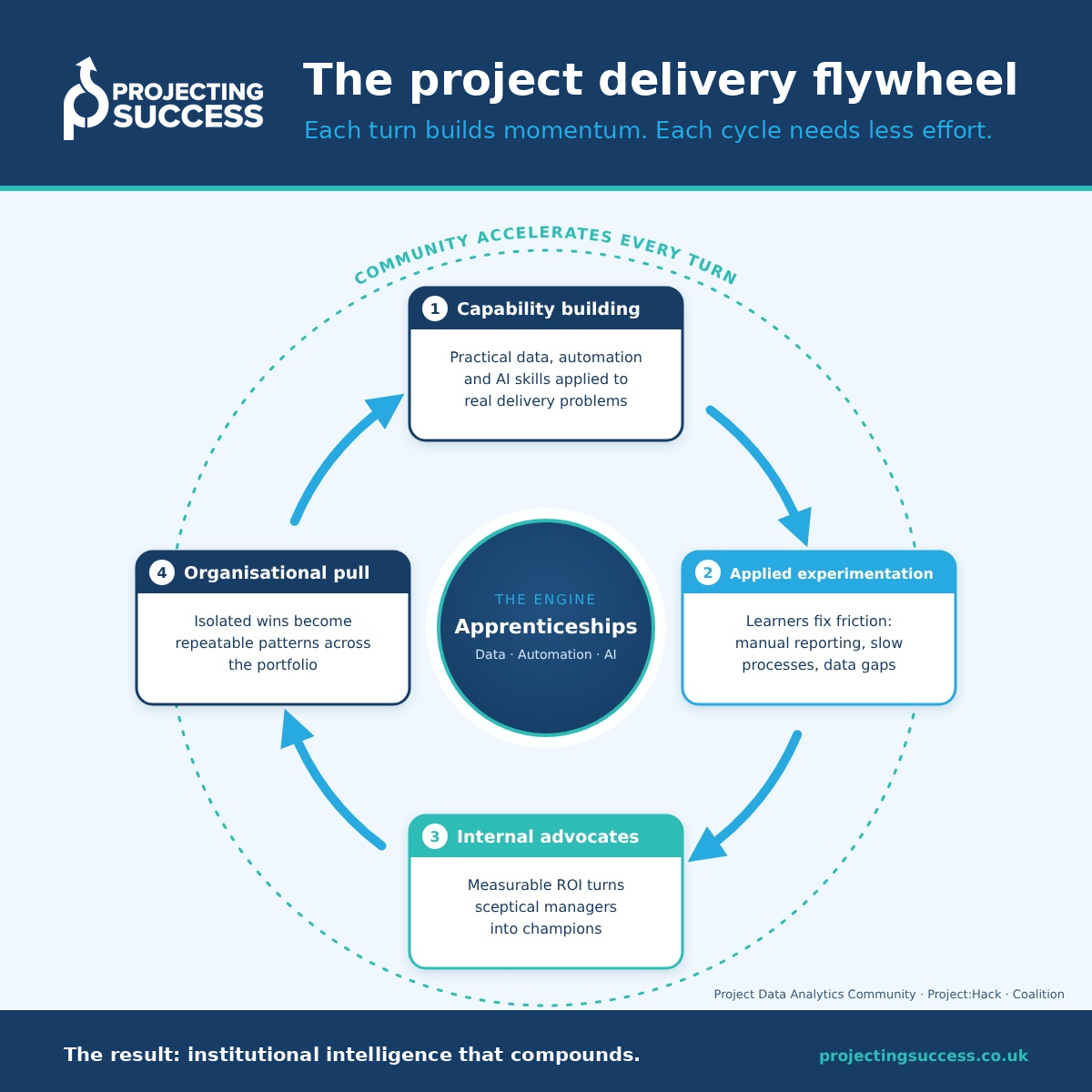

After spending many years in the supply of engineering and digital services, I made a conscious decision that if I wanted to enable real change then I had to start from the bottom up and not the top down. This is how I worked for many years in transforming my own businesses, so why would it be any different when trying to drive data driven changes for clients?
What do I mean? Impactful change only happens from having a community with a shared understanding and believing in the cause. Any change programme is going to hit challenges and falter but unless all the stakeholders believe in the need for cultural change, then it just won’t happen.
How many times have we seen major change initiatives driven from the top or given to one function to impose, that don’t reach their full potential or even worse stall and fail due to a lack of wider commitment and acceptance?
When it comes to creating a real data driven business generating long-term benefits, you must have complete buy in, with a body of stakeholders and change agents that believe in driving a cultural change, understanding the need for a data and AI vison and enthusiasm to embed it into the business culture.
We all know you don’t start with the solution, you start with the problem, you spend time understanding the real underlying issue and then craft the right solution. Over time I have seen too many clients say they are too late to the AI party and need help to buy or implement a specific LLM or AI tool-NO,NO,NO!
Investing in road maps and tools will of course give some immediate benefits but seismic changes and continuous improvements will come from social and cultural change. The way to generate real change is to develop or redevelop your work force, not by just giving them the tools and expecting them to use them, but by embedding a depth of knowledge on the why and developing people to embrace and then lead it to generating the right long term mindset and behaviours.
AI in Project Delivery: Predictions for 2026
As we look towards 2026, the narrative around AI in project delivery is shifting. Paul Nokes (Our Managing Director) and Martin Paver (Founder) recently discussed their predictions for 2026. Let’s jump into what they said:
The era of excitement and experimentation is coming to an end. A new phase is beginning, shaped by accountability, governance and a firmer understanding of what it really takes to transform project delivery. Organisations are discovering that AI does not fail because of the technology. It fails because the foundations are not ready. It fails because meaning is inconsistent, roles are unclear, workflows are fragmented and architectural debt has been allowed to accumulate for years.
2026 will be the year when these truths become unavoidable. Hype will collide with governance. Vanity projects will fall away. And project delivery will begin to move into a more disciplined and purposeful phase.
Here are their predictions:
The rise of the next gen project delivery capability lead
In 2026 organisations will begin to elevate a new kind of leader: the next generation capability lead who acts as both architect and steward of how project delivery evolves. Heads of function will no longer be custodians of today’s methods but visionaries who understand how AI, semantics, human judgement and workflow design fit together. Alongside them, a capability manager role will emerge to govern and develop the products that underpin modern delivery, from data models and agent workflows to early-signal routines and assurance patterns. Their remit will span the supply chain because capability cannot stop at organisational boundaries, and they will work closely with learners and practitioners to refine thin slices and ensure that new approaches take root in practice. Some leaders will thrive in this environment while others will struggle to adapt. The organisations that succeed will be those that treat capability leadership as a strategic differentiator and invest accordingly.
The market reckoning arrives
The most significant shift in 2026 will be the arrival of what many are already calling the market reckoning. For years, organisations have invested in generative AI proofs of concept, tools wrapped in a veneer of intelligence and experiments disconnected from operational reality. In 2026, the question of value becomes unavoidable. CFOs will challenge investment that does not deliver measurable outcomes. Boards will want evidence of earlier insight, calmer decision making and reduced variance. Executives will become less interested in demonstrations and more focused on the impact on schedule stability, cost confidence and risk exposure.
We’ll see different layers of capabilities.
1. Proofs of value in a sandbox environment where learners from the Project Data Academy get an opportunity to experiment within loose constraints. It fires them up and helps to inspire others.
2. Investment in the fundamentals. Meaning must become consistent via ontologies and knowledge graphs such as Project Brain. Workflows will crystallise, be challenged and then evolved. Data structures must be more coherent. AI will be expected to operate within governed, explainable and accountable environments. Responsible AI
will become the new standard because anything else becomes too costly and too risky to continue.
3. End to end demonstrators. Capabilities enabled by end to end data pipelines that tackle interface friction and provide earlier insights that benefit both parties. This will deepen collaborative partnerships as solutions become more tightly coupled.
The decline of point solutions in favour of integrated ecosystems
More organisations will reassess their reliance on isolated point solutions as they gain a clearer understanding of AI and data ecosystems. We’ve seen clients procuring solutions that look impressive, but if organisations have the know how they can recreate similar capabilities in house. They will see that shiny, standalone tools have limited value when they cannot integrate with wider workflows or support end to end delivery. As mainstream capabilities from Microsoft and OpenAI mature, users will assemble solutions that match much of what niche products offer, putting pressure on vendors built on novelty alone. The organisations that thrive will be those that treat AI as an integrated capability rather than a collection of disconnected tools.
We’ll see a market fracture between clients who buy and integrate point solutions vs those who opt for a system and platform approach.
Architectural debt can no longer be ignored
2026 will expose the gap between aspiration and architecture. Organisations will begin to see that their delivery systems lack the semantic foundations required for AI to operate with any reliability. AI does not fix fragmentation, it illuminates it. Conflicting definitions, overlapping vocabularies, incompatible processes and decades of accumulated workaround will surface the moment agents begin to act across the system. For many, this will be uncomfortable but necessary. No amount of modelling or processing power can compensate for incoherent meaning. 2026 will be the year when organisations confront the architectural debt that has shaped their delivery practices and recognise that only a unifying semantic framework, such as Project Brain, can provide the coherence needed for next generation capability to take hold.
Organisations will realise they cannot transform alone
Another pattern will become increasingly clear. The idea that an organisation can transform in isolation will fade. Project delivery is an interconnected system. Almost all large programmes rely on ecosystems of primes, sub tiers, partners and clients. AI cannot function cleanly across misaligned interfaces. It will expose the friction between workflows, definitions and assumptions that have long been tolerated. This will force organisations to recognise that they need to take their supply chain or their clients on the journey with them. Not because it is collaborative or socially responsible, but because it is essential for success. Tighter coupling of capabilities will begin to appear, with shared practices, shared interpretations of movement and shared insight routines spreading across delivery ecosystems.
Next generation assurance begins to take hold
In many organisations, assurance has remained a periodic, retrospective activity focused on artefacts rather than emerging behaviour. AI will make this model look increasingly outdated. By the end of 2026, assurance functions will begin to move towards a next generation model. This will be characterised by assurance at source, continuous sensing of movement, earlier interpretation of weak signals and more confident escalation of emerging issues. Agents will provide evidence, highlight inconsistencies and help teams understand how conditions are starting to shift. Human assurance will focus on systemic risks, cross organisational alignment and the behaviours that shape the delivery environment. The cost of surprises will fall. The speed of response will increase. Assurance will begin to look and feel different.
Governance boards become central to success
Many organisations underestimate the role of governance in enabling AI. In 2026, this will change. The reckoning will force leaders to face the reality that AI cannot be treated as a technology project. It is a capability shift that requires direction, prioritisation and clear decision making. Governance boards will emerge to shape where organisations focus their effort. These boards will oversee semantic alignment, workflow design, agent orchestration and the integration of AI into existing delivery practices. The most successful organisations will treat governance as the mechanism that makes AI safe, stable and valuable. The least successful will treat governance as an afterthought and will struggle to achieve meaningful progress.
Agentic workflows become part of everyday delivery
By late 2026, project teams will begin to operate in hybrid human agent environments. Agents will manage repetitive coordination tasks, monitor early movement, check for variance, prepare structured evidence and support decision making. Some organisations will experience their first agent related incidents. A misinterpreted assumption, an unnoticed inconsistency or a poorly governed workflow will cause disruption. This will accelerate the demand for transparency and oversight. Teams will learn to trust agents while also understanding their limitations. The workplace will adopt new rhythms, with humans and machines sharing context, updating each other and working together to stabilise delivery.
Federated AI models dominate major projects
The energy and cost pressures associated with large scale models will drive organisations towards more federated and sovereign architectures. Regulated industries, defence
programmes and major infrastructure clients will demand that AI operates within their own governance and data boundaries. Foundation models will be adapted to local semantics, not the other way around. Knowledge graphs, governed workflows and thin slices of capability will begin to replace monolithic AI deployments. This local control will accelerate the shift towards more explainable and auditable AI.
The capability gap widens
By the end of 2026, the gap between organisations that prepared for cognition and those that did not will be impossible to ignore. Those who invested in shared meaning, early signal routines and next generation capability will operate with greater stability. AI will not close the capability gap. It will expose it.
The human experience evolves
In 2026 we will see a clear shift in workforce movement as project professionals actively seek out organisations that are pushing the boundaries of modern delivery and reject those constrained by legacy processes. The organisations that create calmer, insight-rich environments where signals form earlier and agents shoulder the routine burden will attract the strongest talent. People will choose employers that allow them to demonstrate their capability, experiment with next generation practices and work in hybrid human–agent teams that elevate their contribution. This will become a visible differentiator in the market. Organisations that treat AI as a way to narrow roles rather than expand them will face rising attrition at precisely the moment they need the most capable people.
Looking ahead
2026 will not be a year of sudden breakthroughs. It will be a year of alignment, correction and rediscovery of the fundamentals. The organisations that succeed will be those that face the reckoning honestly, invest in capability leadership and capacity (project people with the skills, knowledge and experience in project data analytics), strengthen governance, align meaning and take their ecosystem with them. The next generation of project delivery is within reach. The question is who will be ready to shape it.