
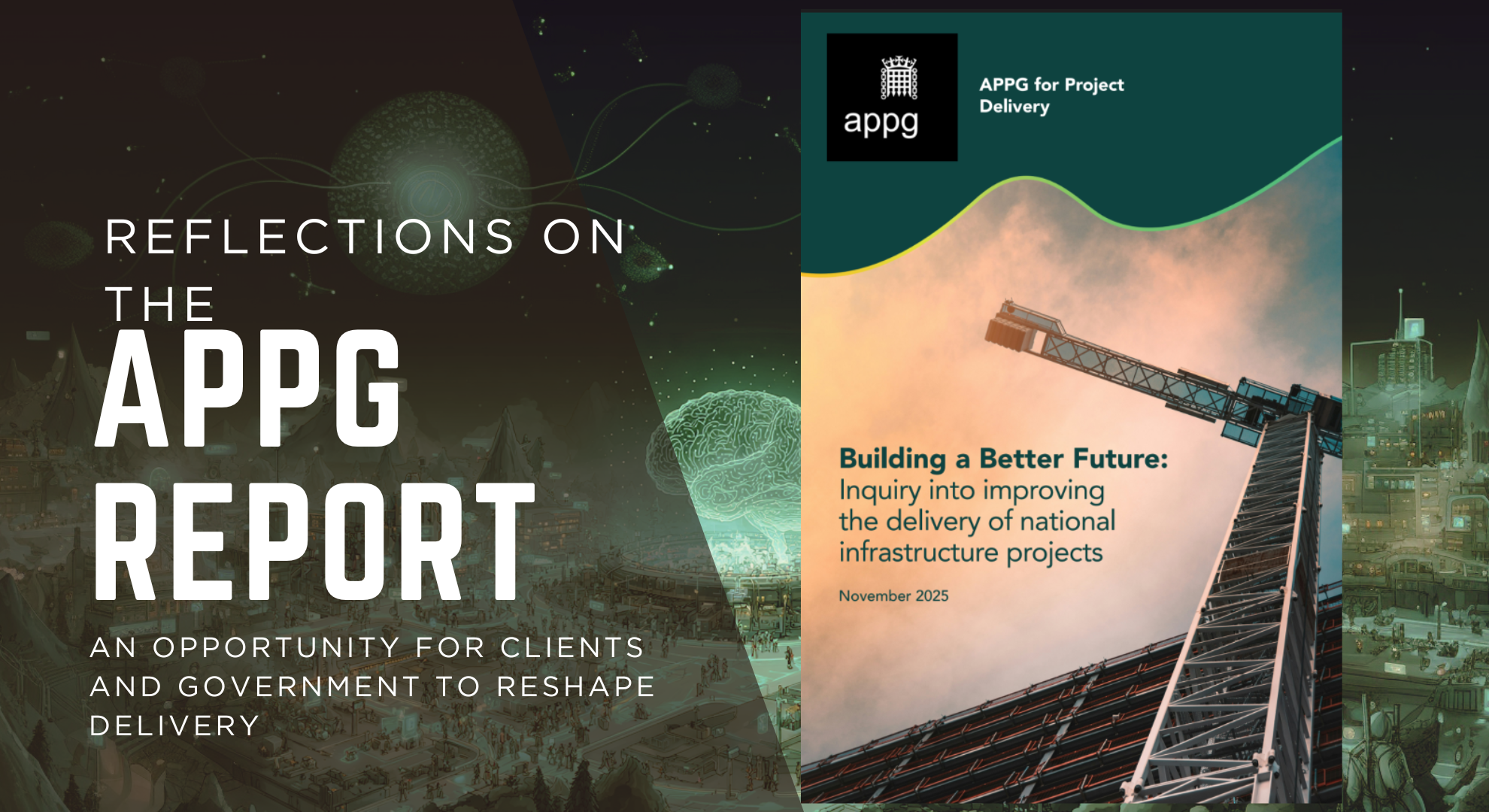
The All Party Parliamentary Group for Project Delivery has released its report on improving the delivery of national infrastructure. Many of the themes we raised in our submission are reflected in the findings, and the report provides a timely platform to accelerate progress. For clients, suppliers and government bodies such as NISTA, the challenge now is to convert the recommendations into practical improvements that strengthen delivery performance today.
A central point in our submission was the need to treat project data as a long-term strategic asset. Clients consistently tell us that they want better forecasting, stronger assurance and earlier visibility of risk. These things depend on consistent, high-quality data that carries forward from project to project. Yet, as we highlighted, the UK continues to lose valuable insight because data is not preserved or stewarded. Crossrail is one of the clearest examples. The delivery data that could have supported benchmarking, predictive analytics and lessons learned across government was never made available. That loss continues to affect portfolios today.
The APPG report recognises this systemic weakness and calls for better access, governance and reuse of project data. For clients, this is not an abstract recommendation. It directly affects how confidently they can plan, how effectively they can assure delivery and how quickly they can respond to early signals of deviation. Better data stewardship means fewer surprises and more predictable outcomes.
We also argued for the importance of independent data institutions. Government cannot manage the entire data ecosystem alone. Trusted, federated stewardship is needed to protect data, ensure it is useful, and make it available for research, innovation and practical delivery improvement. The Construction Data Trust was created for this very purpose, yet engagement was limited. The APPG report opens the door for this idea to be revived in a form that clients and NISTA can actively support.
Another theme from our submission is the need for collaboration across boundaries. Many of the innovations that will drive the next generation of project delivery already exist within the private sector, academia and professional communities. What is missing is the mechanism to bring them together consistently. After a decade of experience, we have seen how community-led hackathons, product groups and the Project Data Analytics Coalition unlock capability that individual organisations cannot generate on their own.
Clients who engage with these communities benefit from faster problem solving, access to practical tools and exposure to new ways of working. NISTA can use these mechanisms to test ideas quickly, build evidence and support capability uplift across government without the delays associated with large central programmes.
The report also highlights the need for clear accountability and measurable progress. In our submission we noted that previous objectives, including the goal of data-driven performance by 2025, lacked transparency on delivery. NISTA now has the opportunity to reset the approach by publishing a clear roadmap, indicators and progress updates that clients can trust. Clarity will help clients align their internal change programmes and build confidence in government direction.
For clients, the practical implications are clear. They can start by treating data as a core delivery asset, not an afterthought. They can experiment with federated data models, participate in cross-sector product groups, and invest in building the capability of their delivery teams. These steps help organisations improve resilience and performance today, while also contributing to stronger national outcomes.
For NISTA, the challenge is to move from strategy to traction. This does not require changing everything at once. Small, visible steps can build confidence quickly: preserving project data, co-developing open standards, supporting federated stewardship, and working directly with delivery communities to test and refine solutions.
The APPG report shows that the momentum is shifting. Many of the ideas that once sat on the fringes are now central to the national debate. The next phase is about delivery. The UK has an opportunity to lead internationally on data-enabled, AI-supported project delivery, but it depends on practical collaboration between clients, suppliers and government.
We stand ready to support that work.