

Most organisations today have invested heavily in business intelligence. Dashboards refresh continuously, performance packs circulate with impressive regularity, and project teams have access to more data than at any point in the history of the profession. On the surface, this should make delivery more predictable and decisions more robust. Yet many leaders will recognise a quieter truth. Projects still surprise them, not because something was hidden, but because the meaning of what was already visible only became clear after the moment to act had passed.
That gap between visibility and understanding is no longer an inconvenience. In complex environments, it is a source of real risk.
I am Martin Paver, founder and chairman of Projecting Success, and over many years working across major programmes in government and industry I have seen this pattern repeat itself with remarkable consistency. Reporting and controls have improved dramatically, but the collective ability to interpret what projects are beginning to tell us has not kept pace with the speed, interdependence and volatility of modern delivery. Business intelligence remains essential, but it is inherently retrospective. It describes what has happened with increasing precision, while offering limited help in understanding how conditions are shifting while there is still time to influence outcomes.
More than a decade ago, I met Dave Snowden, and his thinking on complex adaptive systems immediately resonated. It articulated something I had been experiencing first-hand but lacked the language to describe. Projects were being governed as if they were ordered systems, while behaving unmistakably as complex ones, with outcomes emerging from interaction rather than linear cause and effect. That tension has stayed with me ever since, and the ideas explored in Project Cognition are the result of years spent developing, testing and refining what it actually means to deliver in environments like that.
Projects rarely fail because yesterday’s data was wrong. They fail because early signals were fragmented, interpreted differently across teams, softened as they moved through governance, or disconnected from the assumptions shaping the work. By the time those signals converged into something formally recognisable, the organisation was already reacting rather than shaping, and the cost of intervention had increased sharply.
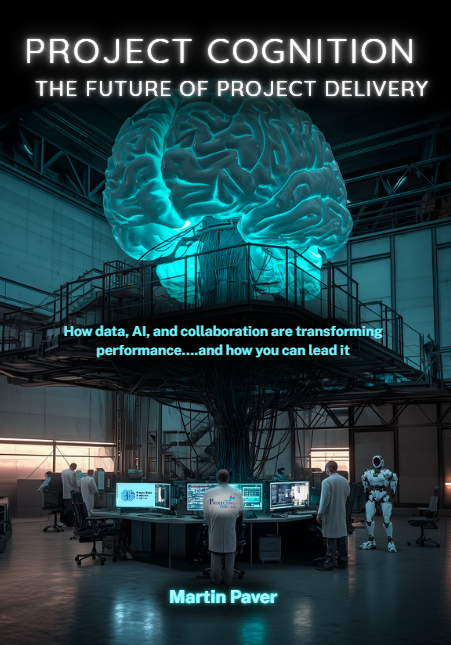
This is the moment Project Cognition focuses on. It explores why visibility alone cannot prevent surprise, and why delivery has become a cognitive challenge as much as a technical one. Projects now behave less like linear plans and more like living systems, where small movements propagate across teams, suppliers and disciplines in ways that traditional reporting was never designed to surface, let alone explain.
At the heart of the book is a simple but demanding idea. Project cognition is the capability of a project organisation to recognise early movement, interpret it collectively and act before consequences harden. This is not about replacing governance, controls or professional judgement. It is about strengthening them by designing for understanding, rather than assuming it will emerge naturally from more data, more meetings or more assurance.
This book is the first in a series that builds the case for a different approach to project delivery. It does not offer a new methodology or a finished blueprint. Instead, it establishes the problem clearly and sets a direction of travel. The books that follow explore specific aspects of cognitive delivery in greater depth, including how projects learn while delivering, how risk accelerates when interpretation slows, how governance can shift from inspection to sensemaking, and how intelligent delivery systems can be built without overwhelming the people who rely on them.
Alongside the books sit playbooks and technical guides that translate these ideas into practical action and architectural choices, supporting organisations, teams and individuals at different points in their journey. Together, they form a coherent body of work that moves deliberately from awareness to capability, rather than offering disconnected tools or one-off interventions.
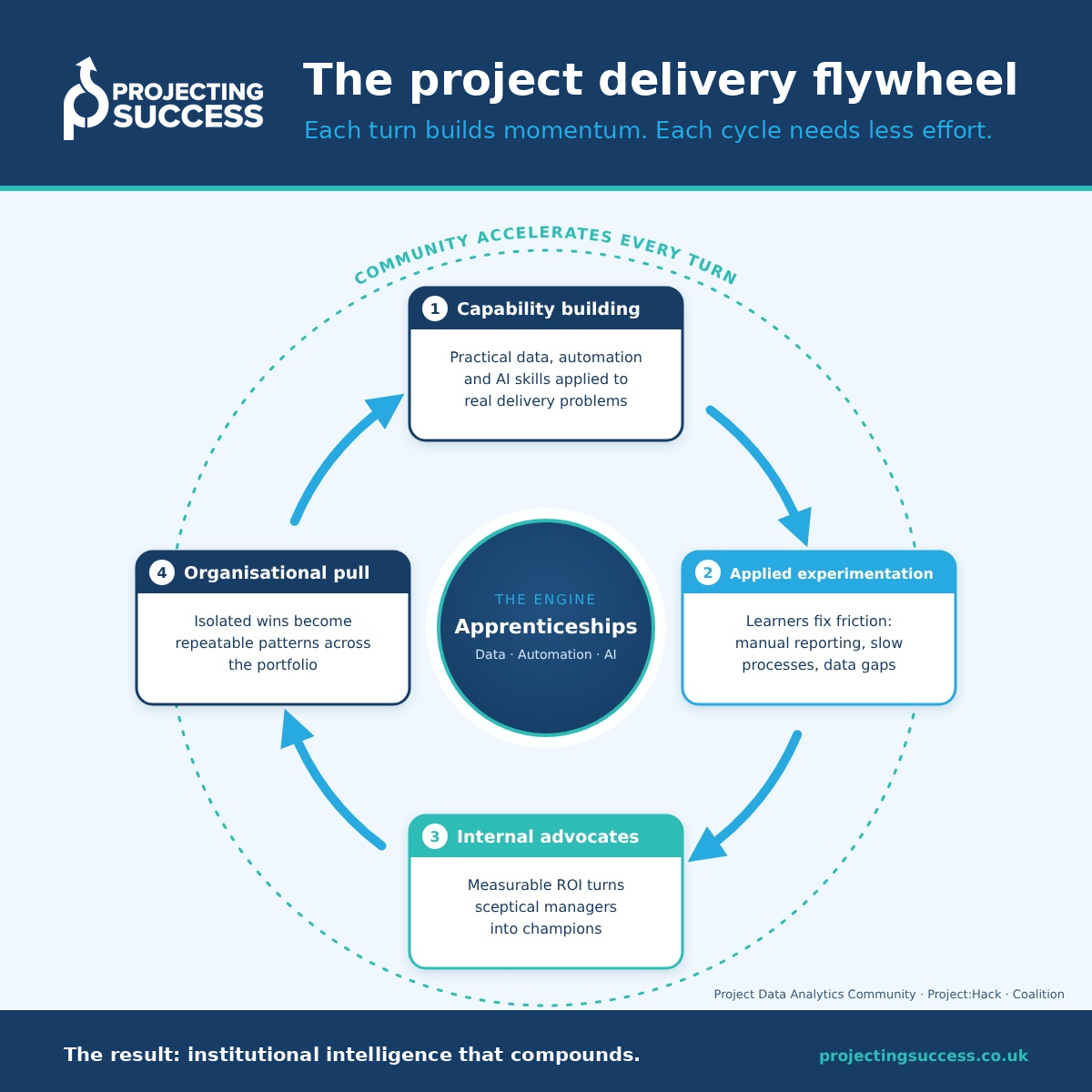
These ideas are grounded in practice. They reflect what is already emerging across the Project Data Analytics Coalition, apprenticeships, product groups and delivery organisations that are experimenting with new ways of understanding delivery as it unfolds. They also reflect a growing recognition that no single organisation can address these challenges in isolation, and that shared learning across the profession is becoming a strategic necessity rather than a secondary concern.
Project Cognition is therefore an invitation, but it is also a challenge. A challenge to move beyond confidence built on hindsight, to treat understanding as a capability in its own right, and to ask whether our current delivery systems are actually designed to notice what matters early enough to change the outcome. This is where the series begins. The books that follow build on that foundation and explore what becomes possible when projects are designed not just to report, but to think.