
Most project delivery organisations are investing in transformation including data strategies, AI pilots, digital tooling and capability programmes. The intent is serious, the budgets are real, and the ambition is genuine.
Yet progress frequently feels frustrating.
Pilots happen and dashboards appear. A proof of concept lands well in a briefing, and then momentum fades. The insight that looked so promising in a quarterly review never quite makes it into the way delivery happens on the ground. The organisation keeps investing. The transformation keeps stalling.
This is one of the most common patterns in the profession right now, and it is not primarily a technology problem.
It is a systems problem.
Why transformation programmes stall — and why it keeps happening
The conventional model for large-scale organisational change assumes that transformation can be designed centrally and rolled out in a structured, predictable sequence. Define the target operating model, select the technology, train the people and embed the change.
Project delivery environments, almost universally, refuse to cooperate with this model.
They are complex adaptive systems, not machines to be reconfigured. Different business units operate with different cultures and data maturity levels, different leadership behaviours and different operational pressures. What works in one part of the portfolio faces entirely different conditions in another. Delivery teams, under pressure to perform, optimise for survival, rather than transformation.
The pattern repeats. Strong executive intent with a capable central programme team and thoughtful change management approach. Then, at the operational layer, the capability required to sustain the change is simply not there in sufficient depth or breadth to create genuine momentum.
The people expected to work differently have not been sufficiently developed to work differently. The technology arrives before the surrounding ecosystem, the analytical skills, the process understanding, the data literacy, and the confidence to experiment has been built.
Technology alone never transforms organisations. People operationalise transformation. And right now, most project organisations do not have enough of the right people, with the right capability, distributed widely enough throughout the system.
The capability gap at the heart of project delivery
This is worth being direct about, because many organisations are still working from an assumption that digital capability lives primarily in specialist teams.
The assumption made sense a decade ago. But the operating environment has shifted. The organisations beginning to pull ahead are not those that have built better central data science teams. They are those that have embedded data literacy, analytical thinking and working familiarity with automation and AI throughout their delivery functions such as PMOs, project controls, assurance teams, delivery managers, planners, risk professionals and operational leads.
When that distributed capability exists, transformation behaves very differently. Changes do not need to be imposed from the top because the people closest to the work have the skills and confidence to drive improvement themselves. Automation does not require a central team to implement every use case because practitioners can identify and build simple automations within their own workflows. AI adoption accelerates because there is a critical mass of people who understand how to use these tools responsibly within a delivery context.
Building that distributed capability is the hard part. And it cannot be done through occasional training events or by hiring a small number of digital specialists into the centre.
This is where the flywheel model becomes genuinely powerful.
How the flywheel works
The flywheel is a concept borrowed from systems thinking, it describes what happens when the components of a system are designed to reinforce one another rather than operate in parallel.
Each turn of the flywheel adds a little more momentum. As momentum builds, each subsequent turn requires less effort.
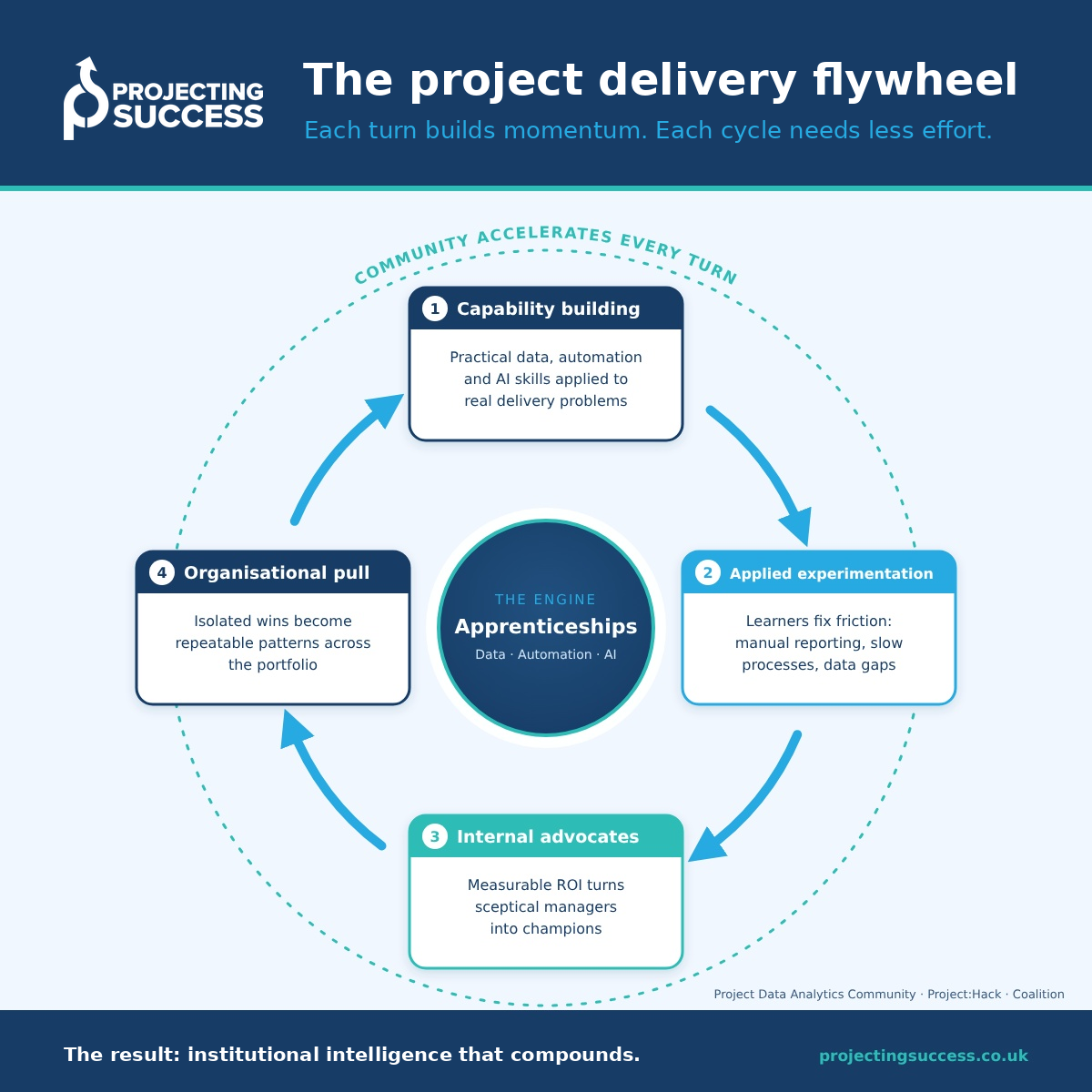
At Projecting Success, we increasingly view our apprenticeships not as standalone training programmes but as the engine that powers a broader transformation flywheel inside the organisations we work with. The wheel turns in a sequence that, once established, becomes self-reinforcing.
It starts with capability building.
Learners develop practical skills in data analytics, automation and AI, applied directly to project delivery problems, inside their own operational environments. Not in a classroom or through abstract case studies but developing real world solutions.
That generates applied experimentation.
Armed with new capability and organisational permission to use it, learners begin identifying friction. Bottlenecks in reporting. Manual processes that could be automated. Data gaps undermining decision quality. Workflows that could be redesigned. Small improvements emerge. Some learner projects deliver measurable ROI.
Those successes create internal advocates.
Managers who were initially sceptical begin seeing tangible operational value rather than abstract learning outcomes. Interest spreads. More teams want involvement. Problems that could never previously be prioritised suddenly have capable people working on them.
That creates organisational pull.
As momentum builds, something important shifts. Isolated learner projects begin revealing wider systemic opportunities. The automation one person built turns out to be a repeatable pattern applicable across multiple teams. The dashboard one learner created becomes the template for a portfolio-level capability. The AI use case that one project team validated creates the confidence and proof point needed to accelerate wider adoption.
And transformation starts to feel less like something being done to the organisation, and more like something growing from within it.
Why community accelerates the flywheel
One of the most underappreciated accelerators in transformation work is shared learning across organisations.
Most project organisations are wrestling with the same problems:
- Fragmented reporting.
- Manual governance.
- Reactive risk management.
- Weak organisational learning loops.
- Limited AI adoption.
- Inconsistent assurance.
The problems are remarkably common, even across very different sectors and delivery contexts.
The conventional response for each organisation, is to develop solutions independently. This is enormously wasteful. It means the same problems are solved dozens of times, in slightly different ways, with the learning staying locked inside individual organisations.
Through the Project Data Analytics Community, Project:Hack hackathons and the Project Data Analytics Coalition, Projecting Success connects learners and organisations into a wider network of shared experimentation and collective problem-solving. Organisations are not left to figure out the future of project delivery alone. They are part of a movement of practitioners actively building it.
This matters for the flywheel because shared learning dramatically reduces the time required to move from experimentation to replicable practice. When an organisation can learn from how dozens of others have approached a similar challenge, what worked, what failed, what conditions enabled adoption, the flywheel turns faster.
The role of ROI projects in closing the gap
A critical component of the flywheel, and one that distinguishes our approach from conventional apprenticeship delivery, is the emphasis we place on operational impact.
Many apprenticeship programmes end at knowledge transfer. A learner completes their programme with demonstrably improved capability and a portfolio of work evidence. That is valuable, but it is not sufficient.
Our approach deliberately extends the ambition. Learners are supported to focus their applied projects on real organisational challenges with genuine operational value. These become the bridge between capability development and transformation.
Sometimes the impact is modest, a small automation, a cleaner dataset, a more useful report. Sometimes it is significant, a tool that is now used across an entire programme, a workflow redesign that saves substantial capacity, an AI application that improves forecasting confidence.
Even relatively modest improvements, when multiplied across cohorts of learners working in parallel across a portfolio, begin to move the needle in ways that single-point interventions cannot.
And something else happens over time. These projects begin surfacing organisational intelligence about transformation itself.
Where are the blockers?
- Which teams consistently unlock impact?
- What enabling conditions matter most?
- Where is leadership support generating outsized returns?
- What prevents good ideas from scaling?
That intelligence does not disappear at the end of a programme. It accumulates. It helps organisations get better at building capability, not just once, but continuously.
From isolated learning to institutional intelligence
As the flywheel matures, the most interesting development is not the individual capability improvements or even the operational outputs. It is what the organisation starts to learn about itself.
The organisation begins developing institutional intelligence around transformation. Patterns emerge. Repeatable approaches become visible. Confidence about what works in this environment, with these constraints, in this delivery culture, starts to compound.
This matters enormously because most organisations currently lack structured mechanisms for learning from transformation activity in any systematic way. Pilots happen, projects conclude. Reports are written and then the learning dissipates, ready to be rediscovered expensively in the next initiative.
The flywheel helps retain and compound that learning. Each cycle adds to what the organisation knows. Each cohort builds on what the last one discovered.
Why this moment is different
The timing of this conversation is not accidental.
AI capability is advancing at a pace that is genuinely unprecedented. Agentic workflows are moving from experiment to operational deployment. Productivity expectations, from clients, governments and boards are ratcheting upward. And the project delivery profession remains, in many organisations, heavily reliant on labour-intensive operational models that were designed for a very different environment.
That gap will not persist indefinitely. The question is not whether the profession will change. It is whether individual organisations will have the capability to shape how that change plays out in their own context or whether they will find themselves reacting to changes others have already made.
The organisations that will differentiate themselves are unlikely to be the ones with the most impressive AI strategy documents. They are more likely to be the ones that quietly built a robust capability ecosystem around their technology investments, those that understood that the flywheel needed to be built before it could turn.
What working with Projecting Success looks like
We are not simply delivering apprenticeship programmes. We are helping organisations build transformation momentum.
Our apprenticeships sit within a wider ecosystem: community collaboration, applied experimentation, hackathons, shared learning, operational problem-solving and genuine AI exploration grounded in project delivery reality. Employers who engage seriously with this model do not find themselves trying to operationalise change alone.
They become part of a broader movement of organisations reimagining what modern project delivery looks like, how work gets done, how decisions get made, how value gets created and how organisations learn from everything that is happening across their portfolios.
The flywheel is not a training programme. It is a continuously accelerating system of capability, experimentation and organisational learning. Once it is turning, it is very difficult for others to catch up.
If your organisation is ready to stop treating transformation as a series of disconnected events and start building a system that compounds, we would welcome the conversation.