

Let us be direct about something.
If you are reading this and considering one of our apprenticeships, you are almost certainly already stretched. You have a demanding job and live projects to manage. Stakeholders who need things, deadlines arriving faster than they should, governance to navigate and a personal life to protect.
The idea of adding a structured learning programme to that reality, probably feels like putting on a backpack while already carrying a full load.
So, the first thing worth saying is we understand that. Most of the people who come through our programmes begin in exactly that position. Most of them, when they reflect on the experience, describe it as one of the more consequential decisions they made in their careers.
Not because it was easy, because it was the right time.
The ground is shifting beneath the profession
Project delivery has operated within a reasonably stable set of norms for decades involving schedules, risk registers, governance frameworks, stage gates, change control. Reports assembled manually and presented upward with knowledge accumulated slowly over careers.
The fundamentals of good delivery are not disappearing. But the environment around them is changing significantly, and the pace of that change is accelerating.
AI, automation and data analytics are beginning to reshape how work gets done across every industry. Project delivery is not exempt from this. In fact, some parts of the profession are likely to look quite different within the next five years. Many of the operational activities that currently consume significant amounts of professional time such as manual reporting, information reconciliation, routine assurance coordination and administrative governance are increasingly automatable.
That can feel threatening, and it is worth being honest about why.
The honest answer is that some tasks will reduce, but tasks are not careers. The people whose value comes from working across the interface between project delivery expertise and emerging technology such as data, automation, AI are not seeing their value diminish. They are seeing it increase.
The profession needs people who can bridge both worlds. People who understand delivery, those who understand the operational reality of projects. Who can look at an inefficient process and see an automation opportunity or can look at a messy dataset and know what questions to ask. Who can apply AI intelligently rather than fear it or can help their organisations navigate this transition rather than simply react to it.
That is where the opportunity is sitting right now. And it is a significant one.
You do not need to become a data scientist
This is probably the most important misconception to address, because it stops a lot of capable people from even exploring what is possible.
The future of project delivery is not going to require every professional to become a software engineer or a machine learning specialist. That is not where the value is, and it is not what these programmes are designed to produce.
What they are designed to produce is something more practical and, in many ways, more rare, project professionals who can work differently.
Those who can ask better questions of data. Those that can identify where automation could free up capacity and can collaborate more effectively with technical specialists because they understand what those specialists are doing and can translate between the technical and the operational. Professionals who can use AI tools intelligently, knowing where they add value, where they fall short, and how to apply them responsibly within a delivery context.
The shift we are describing is not from project professional to technologist. It is from project professionals operating in a traditional way to project professionals operating with significantly expanded capability.
That expanded capability changes what you can offer an employer. It changes the problems you can solve. It changes the conversations you can have. It changes your career trajectory in ways that can be surprising.
The risk of standing still
There is a temptation, and it is entirely understandable, to wait.
Wait for things to settle. For AI to mature enough that its implications become clearer. For the profession to work out what it actually needs. For a better time.
The difficulty is that the people who benefit most from major technological transitions are rarely the ones who waited for certainty. They are usually the ones who engaged early enough to build genuine confidence while the landscape was still forming. They learned by doing, when doing was still accessible with low-stakes. And they arrived at the moment of mainstream adoption already capable, already experienced and positioned.
The people who waited often found that the landscape had already reorganised around them.
That is not a counsel of fear. It is a realistic reading of how transitions like this one have played out historically, across many professions and many technologies. The safest career strategy is rarely to stay still while the ground shifts.
The safest career strategy is learning.
What actually happens when you start
Something interesting happens when learners begin applying these skills, and it happens consistently enough to be worth describing.
Most people arrive with a version of the same anxiety. They worry they are not technical enough and they assume everyone else on the programme knows more than they do. They fear being exposed. They expect the learning to feel alien and difficult and somehow not quite for people like them.
And then they start.
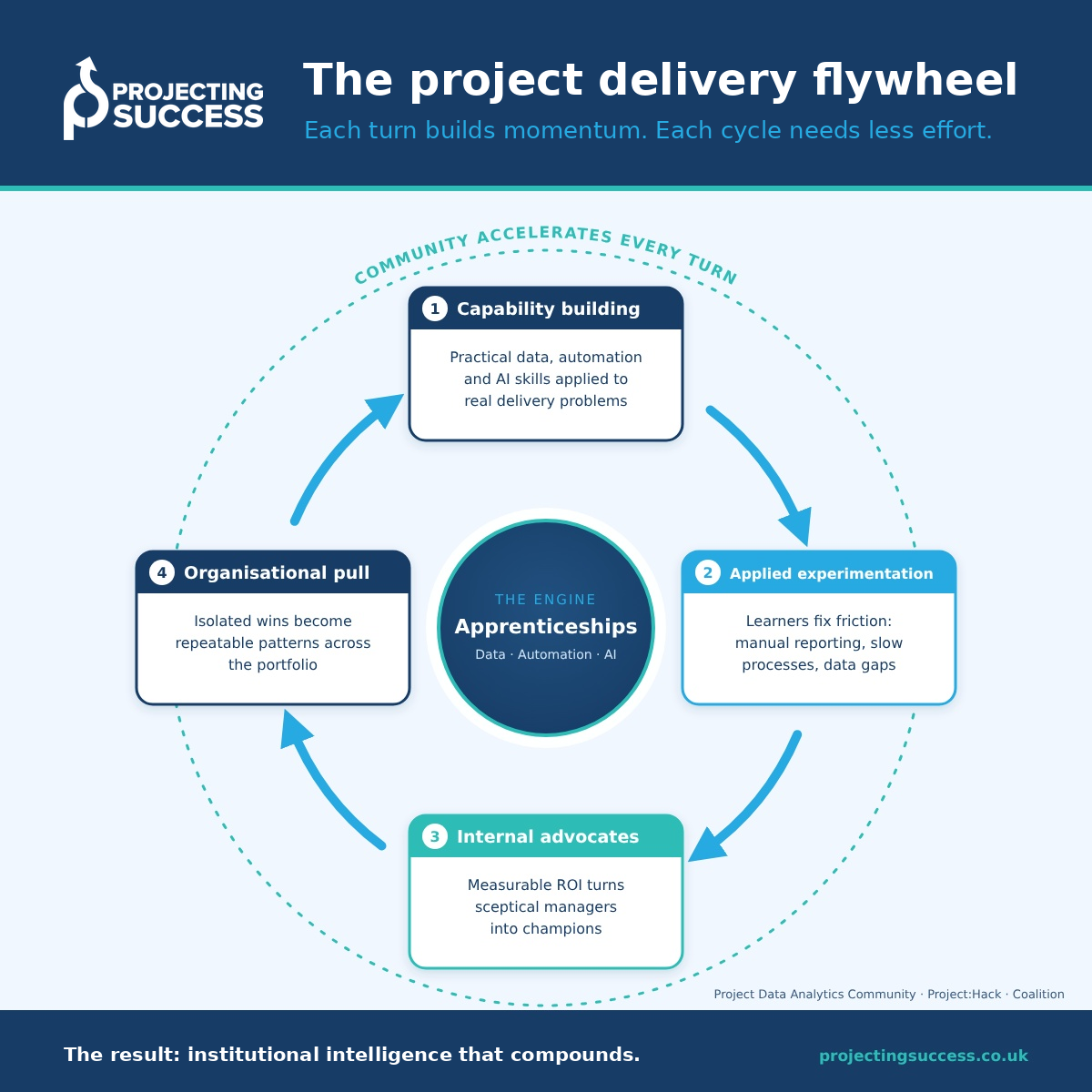
They clean a messy dataset and realise it is not magic, it is a learnable method. They build a simple automation and discover it saves three hours a week. They create a dashboard and see their manager use it to make a better decision in a meeting. They apply an AI tool to a workflow problem and find it genuinely useful rather than mysterious.
The technical anxiety does not disappear overnight but it begins to dissolve, one practical application at a time.
What replaces it is something more valuable: confidence. Not the theoretical confidence that comes from being told you can do something, but the practical confidence that comes from having actually done it.
Once you realise you can improve the systems around you rather than simply operate within them, you begin seeing opportunities everywhere. That shift changes careers.
We have watched it happen repeatedly. People who arrived uncertain about whether this was really for them, who leave with operational tools running in their organisations, capabilities their employers had not anticipated and a fundamentally different sense of what they can offer.
Your project can be your opportunity
One of the aspects of our programmes that most learners come to value most, though few anticipate it at the start is the integration of the learning with real work.
You are not studying disconnected academic examples that you set aside when the module ends. You are applying what you are learning to real problems inside your own organisation. With real data, real constraints and real stakeholders who care about the outcome.
That means your apprenticeship project is not just coursework. It is an opportunity.
An opportunity to solve a frustration that has existed in your team for years. To build something your organisation will actually use and to demonstrate capability in a context where the people around you can see it. To position yourself differently in the eyes of your leadership and to create something that continues delivering value long after the programme ends.
We have seen learners create tools that are now embedded in major programme environments. Automations that have freed up significant team capacity. Dashboards that changed how senior leaders understand their portfolios. AI applications that shifted decision-making quality in measurable ways.
Most of those learners started with nothing more than curiosity and a willingness to engage with an unfamiliar problem.
You are not doing this alone
Something else worth knowing is the scale of the community you would be joining.
Through the Project Data Analytics Community, Project:Hack and the Project Data Analytics Coalition, our learners are connected to a network of practitioners across government, defence, infrastructure, construction, energy, transport and major programmes. People who are working on the same kinds of problems, who share what they discover and who participate in hackathons, peer learning sessions and collaborative experiments.
In a world changing this quickly, that community is not just a nice-to-have. It is practically valuable. Because seeing how others have approached a similar problem, what worked, what they tried first, what constraints they encountered, dramatically accelerates your own capability development.
And perhaps more importantly, it reminds you that you are not navigating this alone. Which, when the learning feels hard, matters more than it sounds.
Why now rather than later
We are at an unusual moment in the evolution of the project delivery profession.
The technology is genuinely changing how work gets done. Organisations are actively trying to work out what this means in practice. The demand for people who can bridge operational project reality and emerging technology capability is real, is increasing and is not yet being met at the scale the profession needs.
That creates a window. Not a permanent one, but a real one.
The people who engage now, who develop practical capability while the profession is still working out what it needs will be disproportionately well placed as that picture clarifies. They will have experience that others do not. Confidence that others are still building. Credibility that comes from having applied these skills in live environments when the stakes were real.
The profession needs translators right now. People who understand delivery from the inside and can help their organisations navigate toward genuinely better ways of working. That is not a role that requires you to abandon your professional identity. It builds on it.
This is bigger than a qualification
Yes, you will gain skills. Yes, you will gain credible, externally recognised qualifications. Yes, you will likely find the programme directly relevant to the challenges you are dealing with today.
But the deeper value is something else.
You are investing in your own relevance in a world that is changing faster than most professional development programmes are designed to accommodate. You are building adaptability, the capacity to keep learning effectively as the environment continues to shift. And you are positioning yourself closer to where the profession is heading, rather than to where it has been.
In the decade ahead, the professionals who thrive in project delivery will not necessarily be the most technically sophisticated. They will often be the most adaptive, the people most willing to learn, experiment, fail usefully, build on what they discover and keep moving.
Curiosity matters more than expertise at the starting line. Resilience matters more than confidence. Practical application matters more than theoretical knowledge.
The future of this profession belongs to the people who can bridge the world of delivery and the world of data, automation and AI. That bridge is learnable. It is being built now. And the people building it earliest, are already moving ahead.
The most consequential career investments are rarely the obvious ones. They are the ones made before the path is clearly visible — when the combination of opportunity and timing is exactly right.
If that sounds like where you are, we would like to talk.